Death and Fair Taxes
Taxation is a relatively new reality for Saudis; before the 2018 introduction of Value Added Tax (VAT), the notion of levying taxes on citizens was not only rejected by most but, to some, was un-Islamic and antithetical to Salafi economic teachings. Bin Baz, a well-known Saudi religious scholar who served as the Grand Mufti of the kingdom in the 90s, famously forbade the practice, deeming it unjust and predatory. Only in the most extreme scenarios is state-sanctioned taxation permissible. Zakat remained the only method of wealth redistribution in the kingdom for the longest time, but even then, it was legally enforced only on commercial entities. Individuals, particularly wealthy ones, were given the freedom to consider whether to give back and fulfill their religious duty or shelve the idea until next year. For so long Saudis would boast about how tax-free their country was, and how other countries’ governments were predatory for going after citizens’ coffers, and the kingdom developed a reputation for being a tax-free state, at least for its native-born citizens.
The continuous fragility of oil prices, however, challenged this longstanding tradition. The oil shocks witnessed between 2014 and 2016, when Brent Crude fell a staggering 70%, alongside the ever-increasing state budget deficit during the same period, posed a significant risk of spiraling into an all-out financial crisis. The state needed money, and austerity measures without a tax policy were a near-fantasy. So, it was inevitable that taxes were soon to become a reality, but the state needed to be careful in its implementation, given the cultural and religious stigma associated with them. The 5% VAT implemented in 2018 was linked to the success of the 2030 diversification mission, which had been announced two years prior to its introduction. The grand design of the crown prince and his administration, now you, the citizen, can be part of this revolutionary economic vision, and contribute to it and be part of its success. Later on in 2020, the VAT tripled to a 15%, a move so outlandish, it could’ve only passed in a global unprecedented health pandemic. Additionally, it was a value-added tax, which only applied through value-added commercial transactions, one step removed from the predatory stigma of income and real-estate taxation, which directly levies funds from your paycheck and capital.
While the choice of VAT might’ve been a smart choice initially, especially at 5%, its longevity in generating state revenue and, more importantly, its wealth redistribution capabilities have proven to be lacking and ineffective. Could other forms of stigmatized tax policies be more effective in filling up governments' pockets and lessening the burden felt by the everyday consumer and worker? In order to analyze the VAT policy and its impact on Saudis, it's important first to clarify what is being taxed here and explain the simple economic concept of Average Propensity to Consume APC.
The 15% VAT, still in effect today, is a consumption tax that applies to all commercial transactions of goods and services at each step of the supply chain, with the exception of financial services, the sale, licensing, and leasing of real estate, and certain life insurance policies, as these activities are fully exempt. Zero-rated goods and services are taxable at 0% at the consumer end; that is to say, no tax is applied during the final step of the supply chain. And they include exports of all kinds, international transportation, some medical and education services, and a handful of precious metals when traded for investment purposes. This VAT policy signals three main goals: steady state finance, export competitiveness, and an investment-friendly environment, leaving wealth redistribution oddly absent from the policy equation. Almost all essential consumption, like food, water, electricity, energy, and fuel, is still taxed at 15%, with no reduced rates on basic goods like bread, eggs, fruits, etc. This fact alone underscores what economists would describe as “A regressive tax policy”. This highlights the regressive nature of the VAT, as it burdens low to middle-income households more than the top earners. Households with a high Average Propensity to Consume APC will be taxed at a higher effective rate. For example, Family A is a struggling family of four with a single earner who works as an office administrator in a small company. Earns 7500 SAR at the end of each month, of which he spends 7000 SAR on food, gas, water, electricity, and a bit of entertainment for his two kids. Only 500 SAR is left to save for the future and therefore will be untaxed. Calculating this family's APC by taking their monthly spending and dividing it by their monthly income: Will result in 93% APC.
This basically means that Family A spends most of what it receives in salary and ends up with an effective tax burden standing at (VAT 15% x 93%) = 13.95% as a share of its income. Applying the same calculation to another household with the same size, Family B, whose monthly income is 15,000 SAR, courtesy of the mom working as a specialist at a large firm. They spend 12,000 on essentials and leisure and deposit the 3,000 remaining in a savings account. Calculating their APC will yield 80%, which leaves them at an effective tax rate of 12%, lower than Family A, a family that’s already hard-pressed for cash. To drive the point home, let's take a last example with family C, also of the same size, and whose main earner is a CEO at a multinational company with a salary package of 80,000 SAR per month. He happens to be a big spender, so on top of essentials and entertainment, he averages around 50,000 SAR in monthly spending and invests 30,000 SAR. That makes his effective tax rate at around 9%, significantly less burdened by the VAT compared to Family B and especially Family A, which is taxed approximately 5% more. I excluded debt and other accounting complexities from these examples for simplification, but the point still stands, and it's important to note that many families have an APC higher than 100%, that is to say, a lot of families rely on borrowing to cover necessities, which can make their effective VAT relative to their income reach 20% and beyond.
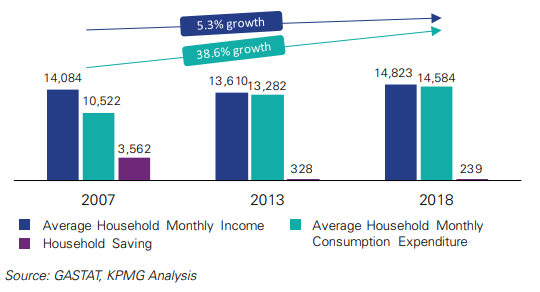
A 2020 report published by KPMG highlights a 38.6% increase in the average household expenditure between 2007 and 2018, a period spanning the introduction of VAT. Around half of this increase was driven by essential categories such as food and utilities. An alarming increase compared to the average household income, which increased only 5.3% in the same period. The middle class is being squeezed, and more of them are experiencing an APC closing on 100%, and with it, a high VAT burden.
Advocates of the Saudi VAT system praise its effectiveness in increasing state revenue, which helps fund public and social services, and in providing benefits that low- and middle-income classes can take advantage of. The disproportionality of the state funding mechanism introduced by the VAT, however, often undermines all wealth redistribution efforts funded by it. A recent 2025 paper published by Oxfam analyzed the European tax system, which includes a VAT similar to our own. It found that most of the state funding comes from ordinary citizens in low- and middle-class brackets, and that the VAT alone contributed 34.3% of the 2022 EU tax revenue, while taxes targeting the upper-class bracket contributed a measly 12.8%, way less than half of what ordinary people pay. This erodes almost all wealth redistribution efforts carried out by the state, through social protection and public services, which make up 76% of the EU government expenditure. The Saudi Street voiced its opinion clearly on the social media site Twitter; the infamous hashtag #الراتب مايكفي الحاجه, which translates roughly to #The_Salary_Isnt_Enough, made a resurgence in 2018 after the implementation of VAT. While not as intense as the 2013 surge, it still saw thousands of posts and accumulated millions of impressions, earning a place on the trending tab. People shared their stories of financial struggle and how the VAT exacerbated the problem, and there was a call for some sort of relief.
This is in no way a call for the rollback of all taxation; it's a necessary state funding mechanism in any modern nation-state. But rather, it's a call for a major reform that would produce a tax system with wealth redistribution as one of its main doctrines. Two major, easy steps towards that goal, and it can be implemented tomorrow, are first a complete VAT exemption for essential food products. As highlighted above, the rising household expenditure on essentials is a major driver of the income shrinkage experienced by low- and middle-income earners. This would provide immediate relief for the majority of working Saudis. Secondly, a clear distinction between luxury goods, whose demand surges with high income, and a standard good, which has a steady demand regardless of income, must be officially classified in the VAT system. Each category of goods will be subject to a different VAT rate, with luxury goods taxed at 20% VAT and standard goods taxed at 10% VAT. State revenue lost by this change can be supplanted by a progressive income tax levied on both native-born and resident workers. The implementation of income tax will no doubt face greater difficulties in execution and therefore require more time, yet its effectiveness in raising funds for the state in an equitable and, dare I say, fair manner has already been proven globally. Contrary to popular belief, this will have minimal impact on ordinary working people, as it will primarily siphon funds from the upper-middle class and the top 1% of income earners.
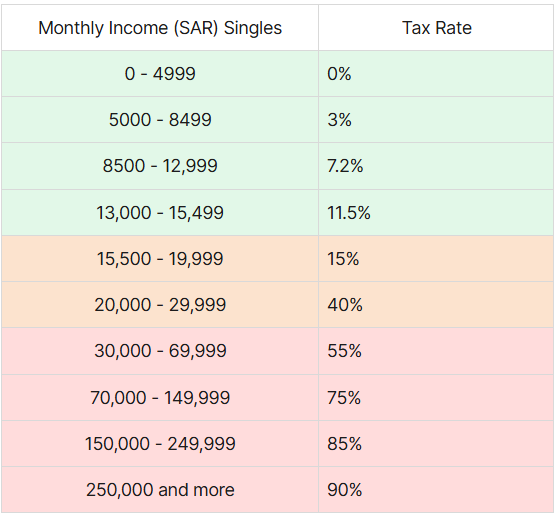
The table above showcases what I believe is an ideal income tax bracket for the kingdom. The first four rows highlighted in green represent around 75% of the Saudi population according to some estimates, and it's where the official median salary of 7,362 Riyals per month, as reported by the General Authority for Statistics, lies. In this row, the lowest margin pays nothing in income tax, while the top margin is taxed at 11.5%. The second segment is made of two rows, where the first begins at approximately the threshold for the top 10%, while the second captures individuals well within the top 5%, and they’re taxed at 15% percent and 40% respectively. The sharper progression in this segment is meant to capture maximum revenue for the state while avoiding adverse effects on aggregate demand, labor market participation, and overall economic activity. Since this threshold has a lower marginal propensity to consume, taxing them at a relatively high marginal rate should limit the impact on economic growth. The last 4 rows highlighted in red represent the top 1% of earners in the kingdom, and it's where around 23% of national income takes place, according to the World Inequality Database. The high margins set in this segment are aimed at capturing excessive executive compensation to efficiently fund public programs and to weaken inflationary demand for assets by the top 1%. The weakened demands of assets will have a downward pressure on their prices, thus reducing barriers for ordinary Saudis to access investment opportunities and start building wealth. To some readers, a top marginal tax rate of 90% might seem extreme and unrealistic, but in reality, this has not only been done before, but was a major contributor to the period dubbed by American economists in the US as the Golden Age of Capitalism, which extended from the 1950s to the late 70s. A post-war America witnessed the greatest reduction of wealth inequality during that period, with massive growth and entrepreneurship pursuits, thanks to a top federal marginal income tax rate of 91%. During that prosperous period, any dollar earned above $200K or $3 million annually in today’s money was taxed at 91%. In our case, any riyals earned above 249K SAR monthly will be taxed at 90%.
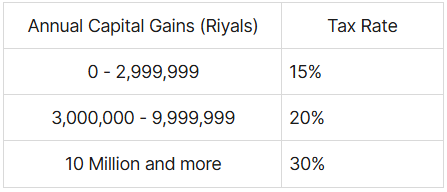
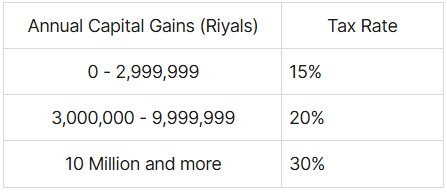
So far, we have only talked about taxing money flow in the form of consumption and income. However, we can’t talk about an effective tax policy without focusing on the biggest concentration of destructive wealth. Most individuals at the top 0.1% of wealth don’t earn income like you and me. Instead, someone like Waleed Bin Talal holds assets in the form of stocks, bonds, and real estate, which constitute most of their massive wealth, resulting in a massive drop in their effective tax rate; that is to say, billionaires in Saudi Arabia pay the least amount of taxes relative to their wealth. A first easy step would be to impose a flat rate of 15% of capital gains tax on asset liquidation. A further 5% should be imposed on any gains that exceed 3 million Riyals annually, and another 10% on gains exceeding 10 million riyals annually. Secondly, increasing the already existing white land (undeveloped land) tax to be 5% on the assessed value of the land per year, and applying the current 2.5% on any real estate holding, developed or otherwise. These are all standard anti-concentration of wealth measures already practiced in many developed countries, and put to great effect, like in the Nordic countries. And yet, their success in closing the gap in the effective tax rates between the 99% of the population and 1% is still inadequate. Loopholes like the infamous buy-borrow-die method, among others, shield the wealthiest from paying their fair share.
Economists struggled with this for decades, as the richest of us are usually income poor but asset rich, and therefore, true and tried methods of taxation failed to tax them effectively. Recently, however, great progress has been made internationally to address this ever-growing problem. One of the leading voices of this movement is the French economist and writer Gabriel Zucman. In 2024, Zucman was invited to the G20 presidency in Brazil to discuss this idea of taxing the so called ultra-high-net-worth individuals in a room full of finance ministers. Later dubbed the Zucman tax, he proposed an internationally coordinated 2% minimum annual wealth tax on individuals with a net worth exceeding $100 million. Extensive research done by Zucman and other economists revealed that many wealthy individuals in numerous countries pay less than 2% of their net worth, with estimates of only 0.3%. If the effective tax rate of a wealthy individual is 0.5%, for example, he/she will have to pay 1.5% minimum of their total net worth every year. Additionally, the Zucman tax does not require liquidation of assets, namely stocks, to pay it, a simple transfer of stock ownership to the state will suffice in covering the 2% required.
If this were to be adopted in Saudi Arabia, a few hundred rich people with a net worth of 100 million Riyals and more, paying the Zucman 2%, can raise billions of riyals for the state and close the long-running budget deficit of the kingdom, opening up for more public spending to levels never seen since King Khalid. Certainly, this will be a major challenge. As it stands right now, the Zucman tax, while it got very close, failed to pass the French Senate, and therefore, we have no tangible records of implementation to review for success or failure. I do still think it's worth discussing, as extreme wealth concentration is becoming a global phenomenon that every state has to face sooner or later.
While it might seem to some that my proposal is some kind of Robin Hood tale of taking from the rich and giving to the poor, the fact of the matter is, all of this is just to level the playing field. Right now, our tax policy in the kingdom resembles a twisted version of Robin Hood, where we are disproportionately taking from the poor and giving to the rich. It's simply unsustainable, and the longer this goes, the more unequal our society will feel. Aside from the economic impact of such a scenario, this also has major implications culturally and socially. Money and wealth are social constructs, constructs that gives its holder power and influence, and unless we’re fine with a few people dictating the future vision of our nation, this power and ability to build wealth must be shared, and Zakat alone as a redistributive mechanism is not enough. Historically, taxes were used for that purpose with varying degrees of success, and if they were truly as inevitable as Benjamin Franklin noted when said "In this world nothing can be said to be certain, except death and taxes." Then we're ought to push for fair taxation to the point of inevitability as well.
الموت والضرائب العادلة
يُعدّ فرض الضرائب واقعًا جديدًا نسبيًا بالنسبة للسعوديين؛ فقبل تطبيق ضريبة القيمة المضافة عام ٢٠١٨، لم يكن مفهوم فرض الضرائب على المواطنين مرفوضًا من قِبل معظمهم فحسب، بل اعتبره البعض مخالفًا للشريعة الإسلامية ومتناقضًا مع تعاليم السلفية الاقتصادية. وقد حرّم بن باز، العالم الديني السعودي المعروف الذي شغل منصب مفتي المملكة في التسعينيات، هذه الممارسة، معتبرًا إياها ظالمة واستغلالية. ولا يُسمح بفرض الضرائب إلا في أقصى الحالات. وظلت الزكاة الوسيلة الوحيدة لإعادة توزيع الثروة في المملكة لفترة طويلة، ولكن حتى حينها، كانت تُفرض قانونًا على الكيانات التجارية فقط. أما الأفراد، وخاصة الأثرياء منهم، فكان لهم حرية الاختيار بين دفع الزكاة وأداء واجبهم الديني أو تأجيل ذلك إلى العام التالي. لطالما تفاخر السعوديون بإعفاء بلادهم من الضرائب، واصفين حكومات الدول الأخرى بأنها جشعة في استنزاف أموال مواطنيها، واكتسبت المملكة سمعة طيبة كدولة معفاة من الضرائب، على الأقل بالنسبة لمواطنيها الأصليين. إلا أن التقلبات المستمرة في أسعار النفط شكّلت تحديًا لهذا التقليد العريق. فقد مثّلت الصدمات النفطية التي شهدتها المملكة بين عامي 2014 و2016، حين انخفض سعر خام برنت بنسبة مذهلة بلغت 70%، إلى جانب العجز المتزايد في ميزانية الدولة خلال الفترة نفسها، خطرًا كبيرًا بالانزلاق إلى أزمة مالية شاملة. كانت الدولة بحاجة ماسة إلى المال، وكانت إجراءات التقشف دون سياسة ضريبية ضربًا من الخيال. لذا كان من المحتم أن تصبح الضرائب واقعًا قريبًا، لكن كان على الدولة توخي الحذر في تطبيقها، نظرًا للوصمة الثقافية والدينية المرتبطة بها. وقد ارتبط تطبيق ضريبة القيمة المضافة بنسبة 5% في عام 2018 بنجاح مهمة التنويع الاقتصادي لعام 2030، التي أُعلن عنها قبل عامين من بدء تطبيقها. بفضل التصميم الطموح لولي العهد وإدارته، أصبح بإمكانك، أيها المواطن، أن تكون جزءًا من هذه الرؤية الاقتصادية الثورية، وأن تساهم فيها وتكون شريكًا في نجاحها. وفي وقت لاحق من عام 2020، تضاعفت ضريبة القيمة المضافة ثلاث مرات لتصل إلى 15%، وهي خطوة غير مسبوقة، لم يكن من الممكن إقرارها إلا في ظل جائحة صحية عالمية غير مسبوقة. علاوة على ذلك، كانت ضريبة القيمة المضافة تُطبق فقط على المعاملات التجارية ذات القيمة المضافة، وهي بذلك تختلف عن ضريبة الدخل والعقارات التي تُفرض مباشرة على راتبك ورأس مالك، والتي تُشكل وصمة استغلالية. ورغم أن اختيار ضريبة القيمة المضافة ربما كان خيارًا ذكيًا في البداية، خاصة بنسبة 5%، إلا أن قدرتها على توليد إيرادات الدولة، والأهم من ذلك، قدرتها على إعادة توزيع الثروة، أثبتت قصورها وعدم فعاليتها. فهل يمكن أن تكون هناك أشكال أخرى من السياسات الضريبية التي تحمل وصمة اجتماعية أكثر فعالية في زيادة إيرادات الحكومات وتخفيف العبء عن كاهل المستهلك والعامل العادي؟ من أجل تحليل سياسة ضريبة القيمة المضافة وتأثيرها على السعوديين، من المهم أولاً توضيح ما يتم فرضه من ضرائب هنا وشرح المفهوم الاقتصادي البسيط للميل المتوسط للاستهلاك.
لا تزال ضريبة القيمة المضافة بنسبة 15% سارية المفعول حتى اليوم، وهي ضريبة استهلاك تُطبق على جميع المعاملات التجارية للسلع والخدمات في كل مرحلة من مراحل سلسلة التوريد، باستثناء الخدمات المالية، وبيع العقارات وترخيصها وتأجيرها، وبعض وثائق التأمين على الحياة، حيث تُعفى هذه الأنشطة بالكامل. أما السلع والخدمات المعفاة من الضريبة، فتخضع لضريبة بنسبة 0% عند المستهلك؛ أي لا تُفرض أي ضريبة خلال المرحلة الأخيرة من سلسلة التوريد. وتشمل هذه السلع والخدمات جميع أنواع الصادرات، والنقل الدولي، وبعض الخدمات الطبية والتعليمية، وعددًا محدودًا من المعادن الثمينة عند تداولها لأغراض استثمارية. تُشير سياسة ضريبة القيمة المضافة هذه إلى ثلاثة أهداف رئيسية: استقرار الوضع المالي، والقدرة التنافسية للصادرات، وبيئة جاذبة للاستثمار، مما يجعل إعادة توزيع الثروة غائبة بشكل غريب عن معادلة السياسة. لا تزال جميع السلع الاستهلاكية الأساسية تقريبًا، مثل الغذاء والماء والكهرباء والطاقة والوقود، خاضعة لضريبة بنسبة 15%، دون أي تخفيضات على السلع الأساسية مثل الخبز والبيض والفواكه، إلخ. هذه الحقيقة وحدها تُؤكد ما يُطلق عليه الاقتصاديون "سياسة ضريبية تنازلية". يُبرز هذا الطبيعة التراجعية لضريبة القيمة المضافة، إذ تُثقل كاهل الأسر ذات الدخل المنخفض والمتوسط أكثر من الأسر ذات الدخل المرتفع. وستُفرض ضريبة على الأسر ذات الميل المتوسط المرتفع للاستهلاك بمعدل فعلي أعلى. على سبيل المثال، الأسرة (أ) هي أسرة مُعسرة مُكونة من أربعة أفراد، مُعيلها فرد واحد يعمل إداريًا في شركة صغيرة. يكسب 7500 ريال سعودي في نهاية كل شهر، يُنفق منها 7000 ريال سعودي على الطعام والغاز والماء والكهرباء وبعض الترفيه لطفليه. يتبقى 500 ريال سعودي فقط للادخار للمستقبل، وبالتالي لن تخضع للضريبة. لحساب الميل المتوسط للاستهلاك لهذه الأسرة، نقسم إنفاقها الشهري على دخلها الشهري سيؤدي ذلك إلى نسبة 93%.
هذا يعني ببساطة أن الأسرة (أ) تنفق معظم دخلها، ما يؤدي إلى عبء ضريبي فعلي عليها بنسبة 13.95% (ضريبة القيمة المضافة 15% × 93%) كنسبة من دخلها. بتطبيق الحساب نفسه على أسرة أخرى بنفس الحجم، وهي الأسرة (ب)، التي يبلغ دخلها الشهري 15,000 ريال سعودي، بفضل عمل الأم كمتخصصة في شركة كبيرة. تنفق هذه الأسرة 12,000 ريال سعودي على الضروريات والترفيه، وتودع المبلغ المتبقي وقدره 3,000 ريال سعودي في حساب توفير. بحساب معدل الضريبة السنوي، نجد أنه 80%، ما يجعل معدل الضريبة الفعلي عليها 12%، وهو أقل من معدل الضريبة على الأسرة (أ) التي تعاني أصلاً من ضائقة مالية. ولتوضيح الفكرة أكثر، لنأخذ مثالاً أخيراً مع الأسرة (ج)، وهي أيضاً بنفس الحجم، ويعمل فيها المعيل الرئيسي رئيس تنفيذي في شركة عالمية براتب شهري قدره 80,000 ريال سعودي. هو شخصٌ مُسرف، فبالإضافة إلى الضروريات والترفيه، يُنفق شهريًا ما يُقارب 50,000 ريال سعودي، ويستثمر 30,000 ريال سعودي. هذا يجعل معدل الضريبة الفعلي عليه حوالي 9%، وهو أقل تأثرًا بضريبة القيمة المضافة مقارنةً بالعائلة (ب)، وخاصةً العائلة (أ) التي تُفرض عليها ضريبة أعلى بنسبة 5% تقريبًا. لقد استبعدتُ الديون والتعقيدات المحاسبية الأخرى من هذه الأمثلة للتبسيط، لكن الفكرة لا تزال قائمة، ومن المهم ملاحظة أن العديد من العائلات لديها نسبة استهلاك سنوية أعلى من 100%، أي أن الكثير من العائلات تعتمد على الاقتراض لتغطية الاحتياجات الأساسية، مما قد يجعل ضريبة القيمة المضافة الفعلية عليها نسبةً إلى دخلها تصل إلى 20% أو أكثر. يُشير تقريرٌ صادرٌ عن شركة KPMG عام 2020 إلى زيادةٍ قدرها 38.6% في متوسط إنفاق الأسر بين عامي 2007 و2018، وهي الفترة التي شهدت تطبيق ضريبة القيمة المضافة. وقد نتج حوالي نصف هذه الزيادة عن فئاتٍ أساسيةٍ مثل الطعام والمرافق. يمثل هذا ارتفاعًا مقلقًا مقارنةً بمتوسط دخل الأسر، الذي لم يزد إلا بنسبة 5.3% خلال الفترة نفسها. الناتج عن هذا كله هو تعرض الطبقة المتوسطة لضغوط متزايدة، حيث يواجه عدد أكبر منها ارتفاعًا في متوسط الميل للاستهلاك، وما يترتب على ذلك من عبء ضريبي مرتفع.
يشيد مؤيدو نظام ضريبة القيمة المضافة السعودي بفعاليته في زيادة إيرادات الدولة، مما يساهم في تمويل الخدمات العامة والاجتماعية، وفي توفير مزايا تستفيد منها الطبقات ذات الدخل المنخفض والمتوسط. إلا أن عدم تناسب آلية تمويل الدولة التي فرضتها ضريبة القيمة المضافة غالباً ما يقوض جهود إعادة توزيع الثروة الممولة منها. وقد حللت دراسة حديثة نشرتها منظمة أوكسفام عام 2025 النظام الضريبي الأوروبي، الذي يتضمن ضريبة قيمة مضافة مماثلة لضريبة القيمة المضافة في المملكة. وجدت الدراسة إلى أن معظم تمويل الدولة يأتي من المواطنين العاديين من الطبقتين المنخفضة والمتوسطة، وأن ضريبة القيمة المضافة وحدها ساهمت بنسبة 34.3% من إيرادات الضرائب في الاتحاد الأوروبي عام 2022، بينما لم تساهم الضرائب الموجهة إلى الطبقة العليا إلا بنسبة ضئيلة بلغت 12.8%، أي أقل بكثير من نصف ما يدفعه المواطنون العاديون. وهذا يقوض تقريباً جميع جهود إعادة توزيع الثروة التي تبذلها الدولة من خلال الحماية الاجتماعية والخدمات العامة، والتي تشكل 76% من الإنفاق الحكومي في الاتحاد الأوروبي. وقد عبّر الشارع السعودي عن رأيه بوضوح على موقع تويتر. عاد ترند #الراتب_غير_كافٍ_في_الحاجه في الظهور بقوة في عام 2018 بعد تطبيق ضريبة القيمة المضافة. ورغم أنه لم يكن بنفس حدة انتشاره في عام 2013، إلا أنه شهد آلاف المنشورات وملايين المشاهدات، ما جعله يتصدر قائمة المواضيع الرائجة. شارك الناس قصصهم عن معاناتهم المالية وكيف فاقمت ضريبة القيمة المضافة من حدة المشكلة، وطالبوا بتقديم نوع من الدعم.
لا يُعدّ هذا بأي حال من الأحوال دعوةً لإلغاء جميع الضرائب؛ فهي آلية تمويل ضرورية للدولة في أي دولة حديثة. إنما هو دعوةٌ لإصلاح جذري يُفضي إلى نظام ضريبي يقوم على إعادة توزيع الثروة كأحد مبادئه الأساسية. ولتحقيق هذا الهدف، يمكن البدء بتنفيذ خطوتين رئيسيتين سهلتين، وهما: أولاً، الإعفاء الكامل من ضريبة القيمة المضافة على المنتجات الغذائية الأساسية. وكما ذُكر سابقاً، يُعدّ ارتفاع إنفاق الأسر على السلع الأساسية عاملاً رئيسياً في انخفاض دخل ذوي الدخل المنخفض والمتوسط. وهذا من شأنه أن يُخفف العبء فوراً عن غالبية السعوديين العاملين. ثانياً، يجب التمييز بوضوح بين السلع الكمالية، التي يزداد الطلب عليها مع ارتفاع الدخل، والسلع الأساسية، التي يبقى الطلب عليها ثابتاً بغض النظر عن الدخل، وذلك ضمن نظام ضريبة القيمة المضافة. ستخضع كل فئة من السلع لنسبة ضريبة قيمة مضافة مختلفة، حيث تُفرض ضريبة بنسبة 20% على السلع الكمالية، و10% على السلع الأساسية. ويمكن تعويض الإيرادات الحكومية المفقودة نتيجةً لهذا التغيير بضريبة دخل تصاعدية تُفرض على كل من المواطنين والمقيمين. لا شك أن تطبيق ضريبة الدخل سيواجه صعوبات أكبر في التنفيذ، وبالتالي سيستغرق وقتًا أطول، إلا أن فعاليتها في جمع الأموال للدولة بطريقة عادلة، بل ومنصفة، قد ثبتت عالميًا. وخلافًا للاعتقاد السائد، سيكون لهذا تأثير ضئيل على عامة الناس العاملين، إذ سيُحوّل في المقام الأول الأموال من الطبقة المتوسطة العليا وأعلى 1% من أصحاب الدخل.
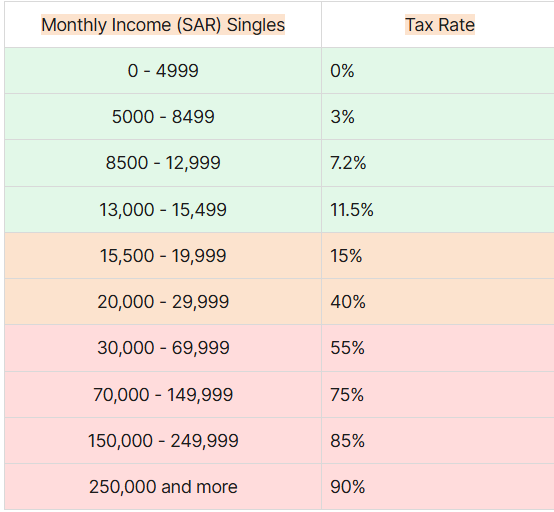
يُظهر الجدول أعلاه ما أعتقد أنه شريحة ضريبة الدخل المثالية للمملكة. تمثل الصفوف الأربعة الأولى المظللة باللون الأخضر حوالي 75% من سكان المملكة العربية السعودية وفقًا لبعض التقديرات، وهي الشريحة التي يقع فيها متوسط الراتب الرسمي البالغ 7,362 ريالًا شهريًا، كما ورد في الهيئة العامة للإحصاء. في هذا الصف، لا يدفع أصحاب الدخل الأدنى أي ضريبة دخل، بينما يخضع أصحاب الدخل الأعلى لضريبة بنسبة 11.5%. يتكون الجزء الثاني من صفين، حيث يبدأ الأول عند عتبة أعلى 10% من اصحاب الدخل تقريبًا، بينما يشمل الثاني الأفراد الذين يقعون ضمن أعلى 5%، ويخضعون لضريبة بنسبة 15% و40% على التوالي. يهدف التدرج الحاد في هذا الجزء إلى تحقيق أقصى قدر من الإيرادات للدولة مع تجنب الآثار السلبية على الطلب الكلي، ومشاركة سوق العمل، والنشاط الاقتصادي بشكل عام. نظرًا لأن هذه الشريحة لديها ميل استهلاكي هامشي أقل، فإن فرض ضريبة عليها بمعدل هامشي مرتفع نسبيًا من شأنه أن يحد من التأثير على النمو الاقتصادي. تمثل الصفوف الأربعة الأخيرة المظللة باللون الأحمر أعلى 1% من أصحاب الدخل في المملكة، حيث يُستحوذ على نحو 23% من الدخل الوطني، وفقًا لقاعدة بيانات عدم المساواة العالمية. تهدف هوامش الاستقطاب المرتفعة في هذه الشريحة إلى استغلال المكافآت الباهظة للمديرين التنفيذيين لتمويل البرامج العامة بكفاءة، والحد من الطلب التضخمي على الأصول من قبل أعلى 1% وهم أصحاب النفوذ. سيؤدي انخفاض الطلب على الأصول إلى ضغط نزولي على أسعارها، مما يقلل من العوائق أمام المواطنين السعوديين العاديين للوصول إلى فرص الاستثمار وبناء ثرواتهم. قد يبدو معدل الضريبة الهامشية الأعلى البالغ 90% متطرفًا وغير واقعي للبعض، لكن في الحقيقة، لم يُطبق هذا المعدل من قبل فحسب، بل كان عاملًا رئيسيًا في الفترة التي أطلق عليها الاقتصاديون الأمريكيون اسم العصر الذهبي للرأسمالية، والتي امتدت من خمسينيات القرن الماضي إلى أواخر سبعينياته. شهدت أمريكا ما بعد الحرب العالمية الثانية أكبر انخفاض في عدم المساواة في الثروة خلال تلك الفترة، مع نمو هائل ونشاط ريادي كبير، بفضل معدل ضريبة الدخل الهامشية الفيدرالية الأعلى البالغ 91%. خلال تلك الفترة المزدهرة، كان أي دولار يُكسب فوق 200 ألف دولار، أو 3 ملايين دولار سنويًا بقيمة اليوم، يُفرض عليه ضريبة بنسبة 91%. أما في حالتنا، فإن أي ريال يُكسب فوق 249 ألف ريال سعودي شهريًا سيُفرض عليه ضريبة بنسبة 90%. حتى الآن، اقتصر حديثنا على فرض الضرائب على تدفق الأموال في صورة استهلاك والدخل. مع ذلك، لا يمكننا الحديث عن سياسة ضريبية فعّالة دون التركيز على أكبر تجمع للثروات المدمرة. فمعظم الأفراد الذين يمثلون أعلى 0.1% من الثروة لا يكسبون دخلًا مثلنا. بل يمتلك شخص مثل وليد بن طلال أصولًا في صورة أسهم وسندات وعقارات، تُشكل معظم ثروته الهائلة، مما يؤدي إلى انخفاض كبير في معدل الضريبة الفعلي عليه؛ أي أن أصحاب المليارات في السعودية يدفعون أقل قدر من الضرائب نسبةً إلى ثرواتهم. وتتمثل الخطوة الأولى السهلة في فرض ضريبة ثابتة بنسبة 15% على أرباح رأس المال عند تصفية الأصول. ينبغي فرض ضريبة إضافية بنسبة 5% على أي مكاسب تتجاوز 3 ملايين ريال سنويًا، و10% أخرى على المكاسب التي تتجاوز 10 ملايين ريال سنويًا. كما ينبغي زيادة ضريبة الأراضي البيضاء (الأراضي غير المطورة) الحالية إلى 5% من القيمة المقدرة للأرض سنويًا، وتطبيق النسبة الحالية البالغة 2.5% على أي حيازة عقارية، سواء كانت مطورة أم لا. هذه كلها تدابير معيارية لمكافحة تركز الثروة، مطبقة بالفعل في العديد من الدول المتقدمة، وفعّالة للغاية، كما هو الحال في دول الشمال الأوروبي. ومع ذلك، لا يزال نجاحها في سد الفجوة في معدلات الضرائب الفعلية بين 99% من السكان و1% منهم غير كافٍ. فثغرات قانونية، مثل طريقة "الشراء والاقتراض والموت" الشهيرة، من بين أمور أخرى، تحمي الأثرياء من دفع حصتهم العادلة.
عانى الاقتصاديون من هذه المشكلة لعقود، إذ أن أصحاب الثروات الطائلة عادةً ما يكونون ذوي دخل منخفض لكنهم يمتلكون أصولاً ضخمة، وبالتالي، فشلت أساليب الضرائب التقليدية في فرض ضرائب فعّالة عليهم. إلا أنه في الآونة الأخيرة، أُحرز تقدم كبير على الصعيد الدولي لمعالجة هذه المشكلة المتفاقمة. ومن أبرز الأصوات الداعمة لهذا التوجه الاقتصادي والكاتب الفرنسي غابرييل زوكمان. في عام 2024، دُعي زوكمان إلى رئاسة مجموعة العشرين في البرازيل لمناقشة فكرة فرض ضرائب على ما يُسمى بالأفراد ذوي الثروات الطائلة، وذلك في اجتماع ضم وزراء المالية. وقد اقترح زوكمان، فيما عُرف لاحقاً بـ"ضريبة زوكمان"، فرض ضريبة ثروة سنوية لا تقل عن 2% على الأفراد الذين تتجاوز ثروتهم الصافية 100 مليون دولار، وذلك بتنسيق دولي. وكشفت أبحاث مستفيضة أجراها زوكمان وغيره من الاقتصاديين أن العديد من الأثرياء في دول عديدة يدفعون ضرائب أقل من 2% من ثروتهم الصافية، حيث تُشير التقديرات إلى أن ما يدفعونه لا يتجاوز 0.3%. إذا كان معدل الضريبة الفعلي على فرد ثري 0.5%، على سبيل المثال، فسيتعين عليه دفع 1.5% كحد أدنى من صافي ثروته سنويًا. إضافةً إلى ذلك، لا تتطلب ضريبة زوكمان تصفية الأصول، وتحديدًا الأسهم، لدفعها، بل نقل ملكية الأسهم إلى الدولة لتغطية نسبة الـ 2% المطلوبة يفي بغرض السياسة. إذا تم اعتماد هذه الضريبة في المملكة العربية السعودية، فإن بضع مئات من الأثرياء الذين تبلغ ثروتهم الصافية 100 مليون ريال أو أكثر، بدفعهم ضريبة زوكمان بنسبة 2%، سيتمكنون من جمع مليارات الريالات للدولة وسد العجز المزمن في ميزانية المملكة، مما يفتح المجال أمام المزيد من الإنفاق العام إلى مستويات لم تشهدها المملكة منذ عهد الملك خالد. لا شك أن هذا سيمثل تحديًا كبيرًا. ففي الوقت الراهن، ورغم اقتراب ضريبة زوكمان من الإقرار، إلا أنها لم تُقر في مجلس الشيوخ الفرنسي، وبالتالي، لا توجد لدينا سجلات ملموسة لتطبيقها لتقييم نجاحها. مع ذلك، أعتقد أن الأمر يستحق النقاش، إذ أن تركز الثروة المفرط أصبح ظاهرة عالمية ستواجهها كل دولة عاجلًا أم آجلًا.
قد يبدو اقتراحي للبعض وكأنه قصة روبن هود عن أخذ المال من الأغنياء وإعطائه للفقراء، لكن الحقيقة هي أن كل هذا يهدف إلى تسوية الساحة. فسياستنا الضريبية الحالية في المملكة أشبه بنسخة مشوهة من قصة روبن هود، حيث نأخذ من الفقراء ونعطي الأغنياء بشكل غير متناسب. هذا الوضع غير مستدام، وكلما طال أمده، ازداد شعور مجتمعنا بالغيض حيال عدم المساواة. وبغض النظر عن الأثر الاقتصادي لهذا السيناريو، فإنه يحمل أيضًا تداعيات ثقافية واجتماعية كبيرة. فالمال والثروة مفاهيم اجتماعية، تمنح صاحبها السلطة والنفوذ، وما لم نرضَ بأن يملي قلة من الناس رؤية مستقبل أمتنا، فلا بد من تقاسم هذه السلطة والقدرة على بناء الثروة، ولم تعد الزكاة وحدها، كآلية لإعادة توزيع الثروات، كافية. تاريخيًا، استُخدمت الضرائب لهذا الغرض بنجاح متفاوت، ولو كانت حتمية كما أشار بنجامين فرانكلين حين قال: "لا شيء مؤكد في هذا العالم إلا الموت والضرائب". فينبغي علينا أيضاً أن نسعى جاهدين لتحقيق ضرائب عادلة إلى حد الحتمية.
Sources:
 Autor: WID.world